


A production-grade, open-source AI Engineering codebase and educational curriculum built with PyTorch 2.x. Designed for Software Engineers, ML Engineers, Backend Engineers, and AI professionals who build scalable, high-performance deep learning systems.
preview: preview
Guide link: Guide use FREE50 to get 50 % discount
Source code: link
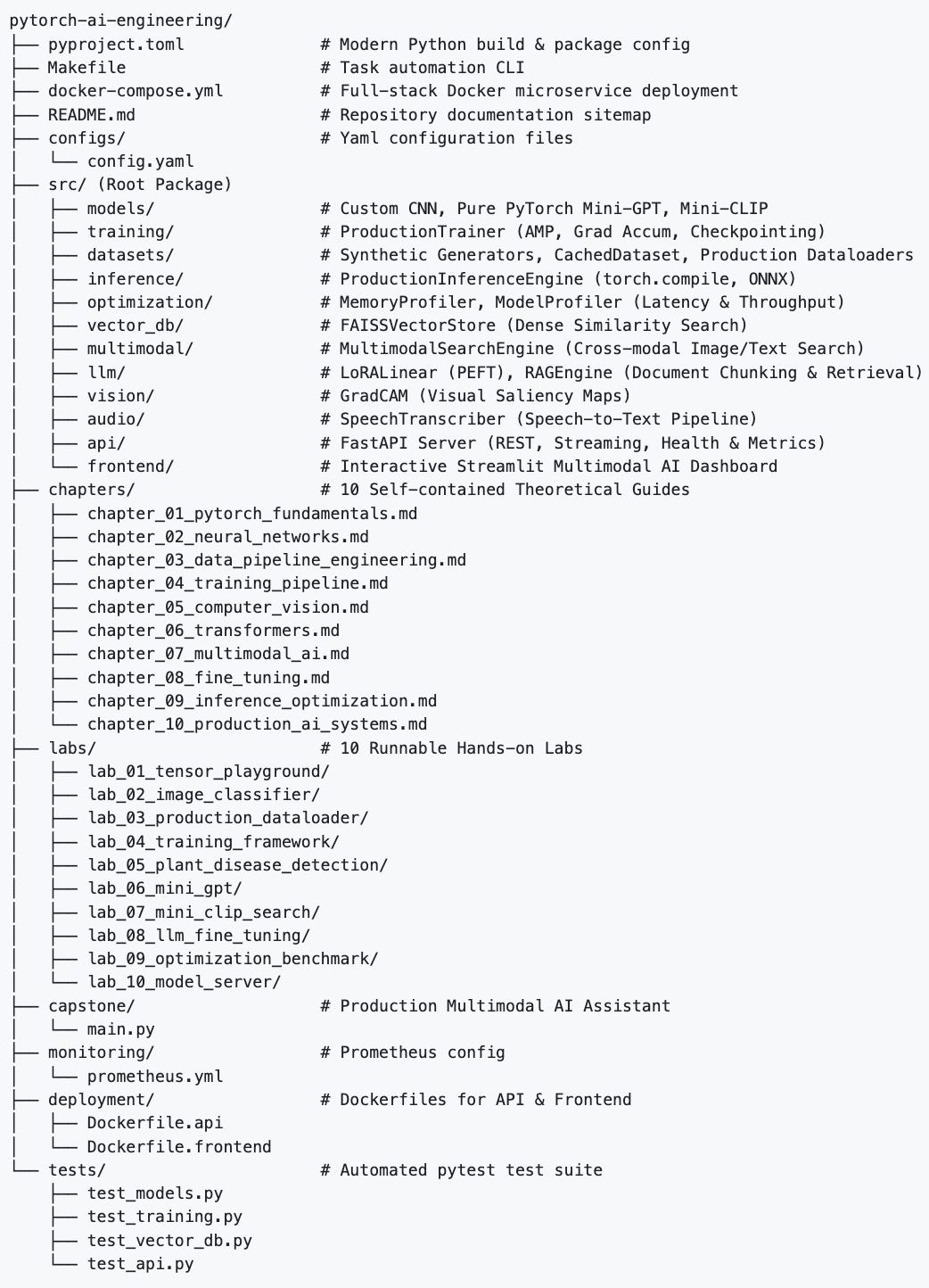
Lab structure
50 Most Asked Interview Questios for Pytorch (Answer in the ebook)
1. PyTorch Fundamentals
What is PyTorch, and how does it differ from other deep learning frameworks like TensorFlow?
Explain the concept of Tensors in PyTorch.
In PyTorch, what is the difference between a Tensor and a Variable?
How can you convert a NumPy array to a PyTorch Tensor?
What is the purpose of the .grad attribute in PyTorch Tensors?
Explain what CUDA is and how it relates to PyTorch.
How does automatic differentiation work in PyTorch using Autograd?
2. Neural Network Design with PyTorch
Describe the steps for creating a neural network model in PyTorch.
What is a Sequential model in PyTorch, and how does it differ from using the Module class?
How do you implement custom layers in PyTorch?
What is the role of the forward method in a PyTorch Module?
3. Training and Optimization Techniques
In PyTorch, what are optimizers, and how do you use them?
What is the purpose of zero_grad() in PyTorch, and when is it used?
How can you implement learning rate scheduling in PyTorch?
Describe the process of backpropagation in PyTorch.
Explain how gradient clipping works in PyTorch and why it may be necessary.
4. Debugging and Model Improvement
How do you check if your PyTorch model is utilizing the GPU?
What strategies can you use to monitor and decrease overfitting in a PyTorch model?
Explain batch normalization and its effects on training convergence.
How does PyTorch handle weight initialization for neural networks?
What are some common issues you may encounter when training models in PyTorch, and how do you troubleshoot them?
5. Data Handling and Preprocessing
How do you create a data loader in PyTorch for custom datasets?
What is the use of transforms in PyTorch’s torchvision package?
How do you manage and preprocess time-series data in PyTorch for RNNs?
Explain the concept of data augmentation and its implementation in PyTorch.
6. Advanced Topics
How do you use GPU accelerators for distributed training in PyTorch?
Explain transfer learning and its implementation in PyTorch.
Compare recurrent neural networks (RNNs), long short-term memory networks (LSTMs), and gated recurrent units (GRUs) in the context of PyTorch.
What is PyTorch’s TorchScript, and how does it aid in deploying PyTorch models in production environments?
7. Coding Challenges
Implement a PyTorch DataLoader for a given CSV dataset.
Code a Python script that demonstrates tensor operations, such as slicing, indexing, concatenating, and transposing, using PyTorch.
Create a simple feedforward neural network in PyTorch that works on the MNIST dataset.
Write a PyTorch function to manually compute the gradients for a basic linear regression model.
Use PyTorch to implement a convolutional neural network (CNN) for image classification.
Write a Python script using PyTorch to save and load a trained model.
8. Case Studies and Scenario-Based Questions
How would you handle imbalanced classes when training a classification model in PyTorch?
How can PyTorch be utilized for real-time inference, and what concerns would you have in such a setting?
Discuss a scenario where you would need to convert a PyTorch model to ONNX format.
Propose a method for deploying a PyTorch model as a REST API service.
Describe your approach to fine-tuning a pre-trained model in PyTorch for a new task.
9. Advanced Topics and Research
What are Graph Neural Networks (GNNs) and how can they be implemented in PyTorch?
Discuss the latest research on neural architecture search (NAS) and its application within PyTorch.
How can generative adversarial networks (GANs) be implemented in PyTorch, and what are some of their challenges?
Explain the concept of model quantization in PyTorch and when it is useful.
What is the role of PyTorch in reinforcement learning research, and can you provide an example?
10. Practical Implementations and Contributions
How would you create a PyTorch extension module with custom C++/CUDA operations?
Describe your experience contributing to PyTorch’s open-source community or using community-created tools.
Discuss a project where PyTorch played a key role in developing a machine learning solution.
How do you ensure reproducibility of experiments when using PyTorch?
Portray how PyTorch Lightning can simplify the standard PyTorch workflow.
Apply coupon code below 100% FREE 👇👇👇
