


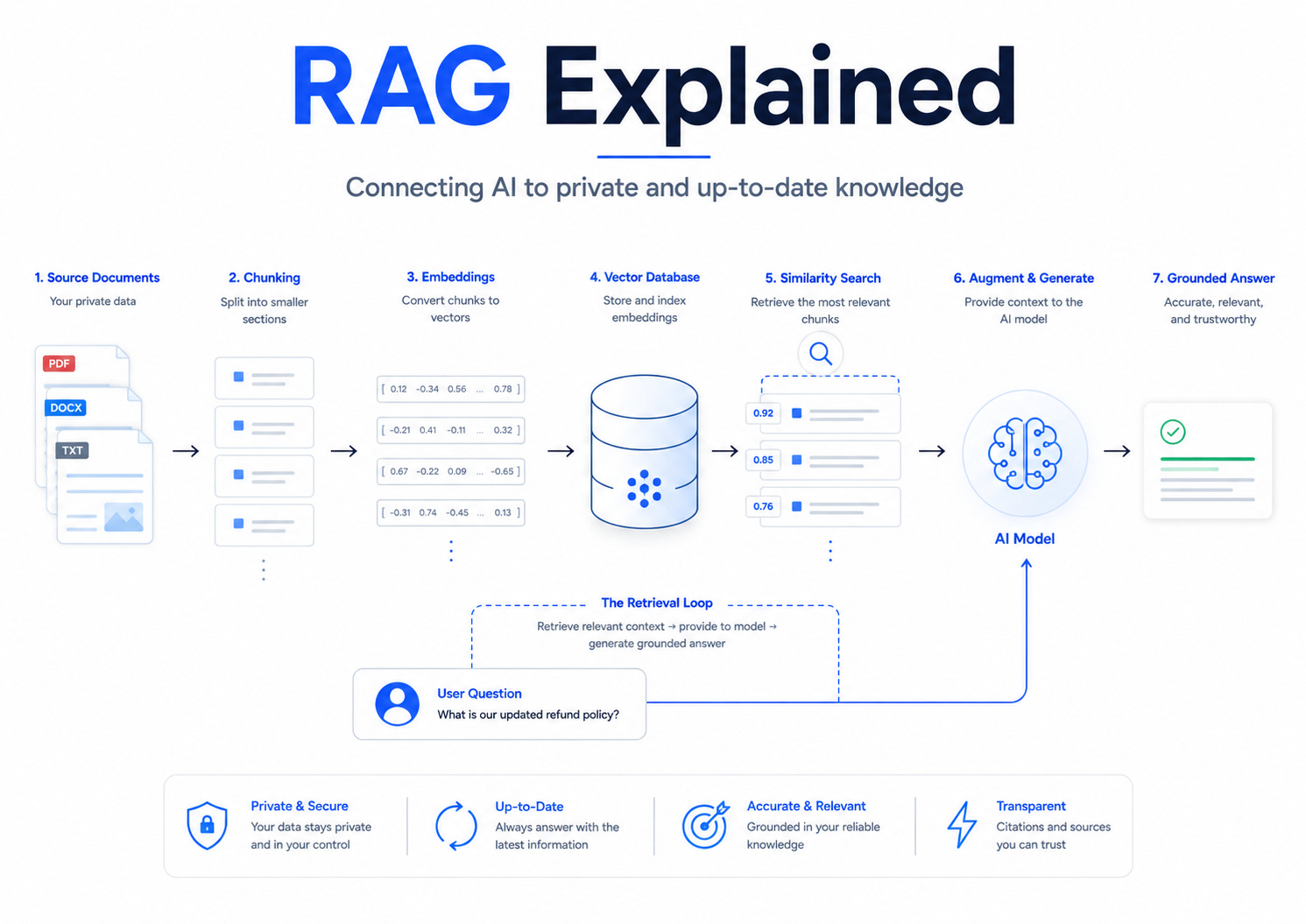
In this video, we explain how RAG connects large language models to private, specific, and up-to-date information without the need for expensive fine-tuning. Instead of permanently changing a model’s internal weights, RAG retrieves relevant document snippets and injects them into the prompt as context, allowing the AI to generate more accurate, grounded, and auditable responses.
You will learn how the RAG pipeline works from end to end, including document chunking, text embeddings, vector databases, similarity search, cosine similarity, and context retrieval. We also compare RAG with fine-tuning and explain why RAG is often the better choice for enterprise AI systems, knowledge bases, customer support bots, internal search tools, and AI assistants.
Whether you are learning AI engineering, building a chatbot, preparing for an AI interview, or designing a production-grade LLM application, this guide will help you understand why RAG has become the industry standard for reliable knowledge retrieval.
Topics covered:
↳ What Retrieval-Augmented Generation is
↳ RAG vs fine-tuning
↳ Why RAG reduces hallucinations
↳ Document chunking
↳ Text embeddings
↳ Vector databases
↳ Cosine similarity search
↳ Context injection into prompts
↳ Private and up-to-date knowledge retrieval
↳ Building production-ready AI applications
Subscribe for more practical AI Engineering, LLM, RAG, Agentic AI, and production-grade machine learning content.
#RAG #RetrievalAugmentedGeneration #AIEngineering #LLM #VectorDatabase #TextEmbeddings #SemanticSearch #MachineLearning #ArtificialIntelligence #GenerativeAI


