


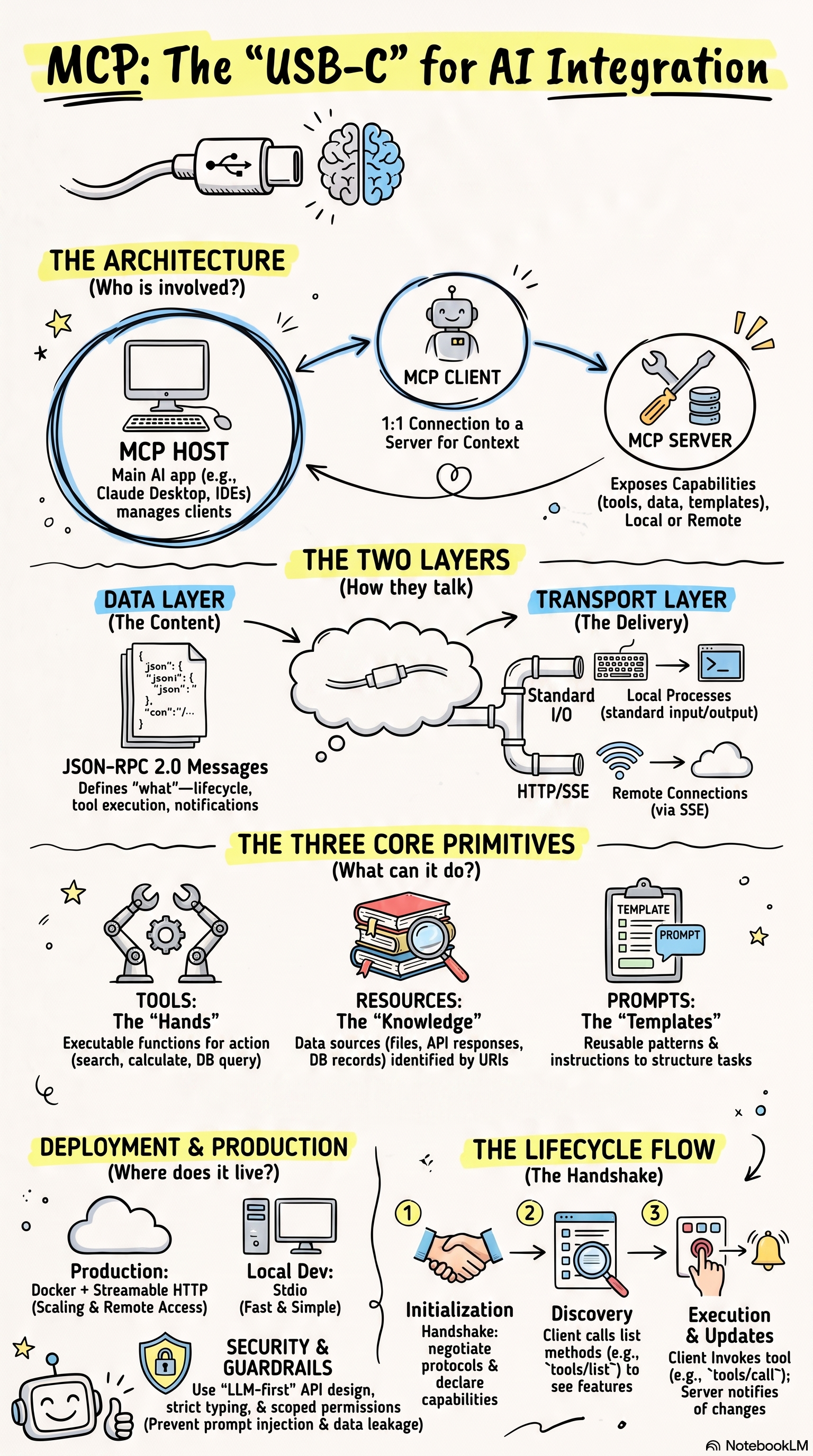
1️⃣ Standardized Communication Layer: The Model Context Protocol (MCP) acts as a universal “USB-C” interface using JSON-RPC, allowing AI models to interact with external tools, systems, and data sources without writing custom glue code for every integration.
2️⃣ Three Core Primitives: MCP servers expose their capabilities through three main features: Resources (read-only data like files or databases), Tools (executable functions the AI can call), and Prompts (reusable interaction templates).
3️⃣ Transport Mechanisms: MCP communication relies on two main transports: Stdio for local, single-client communication (such as running a local tool via Claude Desktop), and Streamable HTTP for remote, multi-client, or production server environments.
4️⃣ LLM-First Tool Design: To ensure an AI reliably uses MCP tools, developers must provide highly descriptive tool names, strictly typed parameter schemas (often using tools like Zod), and structured return formats that an LLM can easily reason about.
5️⃣ Interactive Debugging: Developers can use the MCP Inspector, an interactive browser-based developer tool, to test connectivity, manually execute tools, preview prompts, and monitor JSON-RPC messages before wiring the server to an AI host.
6️⃣ Production Containerization: When moving from local tests to production, it is recommended to package the MCP server using Docker, use the Streamable HTTP transport, and place the container behind a reverse proxy (like Nginx) to handle TLS, CORS, and rate-limiting.
7️⃣ Security and Access Control: For enterprise environments, MCP servers must implement user-scoped data access and authentication (such as Bearer tokens or OAuth) to prevent unauthorized access and protect against vulnerabilities like prompt injections.
8️⃣ Multi-Agent Orchestration: MCP is foundational for scalable multi-agent architectures, allowing you to decouple business logic from API integrations so that highly specialized agents (e.g., orchestrators or data processors) can securely share tools and collaborate.
9️⃣ Persistent Agent Memory: Developers leverage MCP to solve the “stateless” nature of LLMs by building servers that expose read_memory and write_memory tools, allowing AI agents to maintain persistent identities and shared context across sessions and different client interfaces.
🔟 Latency and Performance: Benchmarks show that the MCP protocol itself adds minimal latency (around 10ms for in-process), meaning that any significant slowdowns usually stem from network transitions, Docker overhead (around 169ms), or heavy computational steps like reranking and vector embeddings.


