


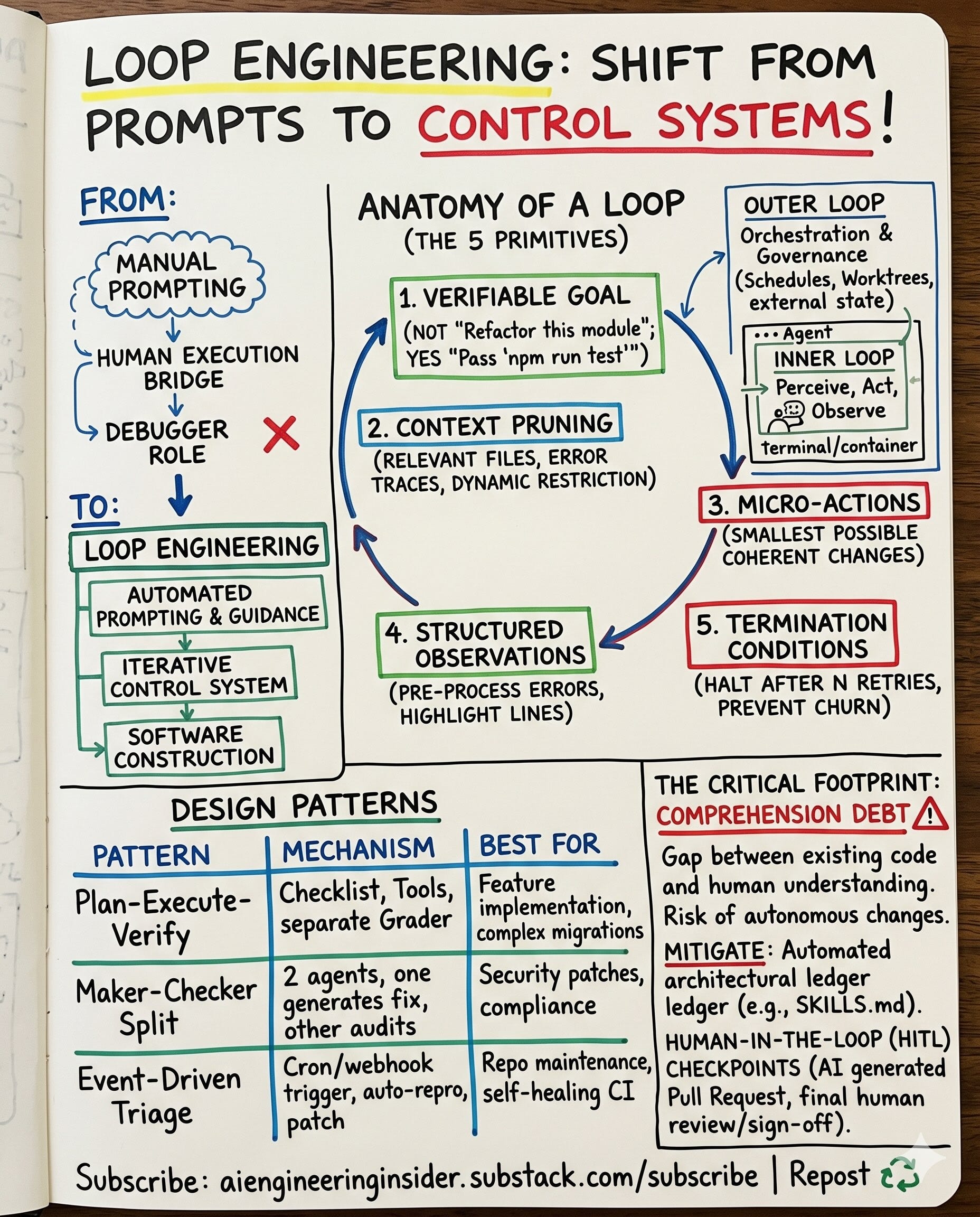
For the past few years, the default mental model for AI-assisted development has been painfully linear:
Write a prompt → Copy the code → Find a bug → Write another prompt.
In that workflow, you are everything: the orchestrator, the runtime, the evaluator, and the debugger.
That paradigm is ending.
Welcome to Loop Engineering.
Loop Engineering is the design discipline of moving beyond manual prompt iteration and toward building automated systems that prompt, execute, verify, and guide AI agents autonomously.
Instead of treating an LLM as a one-shot code generator, Loop Engineering treats software development as a closed-loop control system.
This is the architectural foundation behind elite autonomous coding environments such as Claude Code, OpenAI Codex, and OpenClaw.
The shift is profound:
The future of AI engineering is not prompt engineering. It is control-system engineering.
1. The Anatomy of an AI Engineering Loop
A loop is a recursive, goal-driven execution cycle.
Rather than requiring a human at every step, a well-engineered loop operates autonomously through structured iteration:
Goal → Context → Action → Observation → Evaluation → Retry / StopEach cycle should move the system closer to a verifiable objective.
The Five Core Primitives of Loop Design
To build effective loops, you need five structural pillars.
1. Verifiable Goals
A loop is only as good as its termination criteria.
Vague objectives create vague behavior.
Bad goal:
“Refactor this module.”
Good goal:
“Code passes
npm run testandnpm run lintwith zero warnings.”
The agent must know exactly what success looks like—and success must be machine-checkable.
2. Context Pruning
LLMs degrade when overloaded with irrelevant context.
A strong loop aggressively minimizes what the model sees:
Only relevant files
Immediate dependency graph
Latest failure traces
Current task state
This keeps reasoning focused and reduces token waste.
Context selection is becoming one of the most important infrastructure problems in AI engineering.
3. Micro-Actions
Large speculative rewrites create chaos.
Autonomous agents perform best when constrained to the smallest coherent change:
Edit one file
Modify one function
Upgrade one dependency
Then validate immediately.
Small actions produce fast feedback and reduce blast radius.
4. Structured Observations
Raw logs are noisy.
Dumping a 200-line stack trace into an LLM creates cognitive overload.
Good loop systems preprocess observations:
Highlight failing lines
Summarize root causes
Mark repeated failures
Distinguish new errors from existing ones
This transforms noise into actionable signal.
5. Rigid Termination Conditions
Unbounded retries are expensive and dangerous.
Without limits, agents burn tokens as they endlessly churn code.
Every loop needs explicit ceilings:
Stop after 10 iterations
Stop after 3 repeated failures
Escalate to human review if confidence drops
A loop without termination is not autonomy.
It is entropy.
2. Inner Loops vs Outer Loops
Production AI systems typically operate with two layers of control.
Inner Loop (Perceive → Act → Observe)
The inner loop handles local execution.
This is where the agent:
Reads code
Applies diffs
Runs tests
Captures
stderrIterates until the local objective is satisfied
Think of this as the execution engine.
Outer Loop (Orchestration & Governance)
The outer loop manages higher-level coordination.
It typically runs on:
Cron schedules
Webhooks
CI failures
Pull request events
Responsibilities include:
Spawning isolated git worktrees
Assigning tasks to specialized agents
Tracking long-term goals
Managing retries and escalation
Maintaining audit trails
Think of this as the control plane.
The inner loop writes code.
The outer loop governs the system.
3. Core Loop Design Patterns
When building agentic systems using frameworks like LangGraph, LangChain, or OpenAI Agents SDK, three-loop patterns dominate.
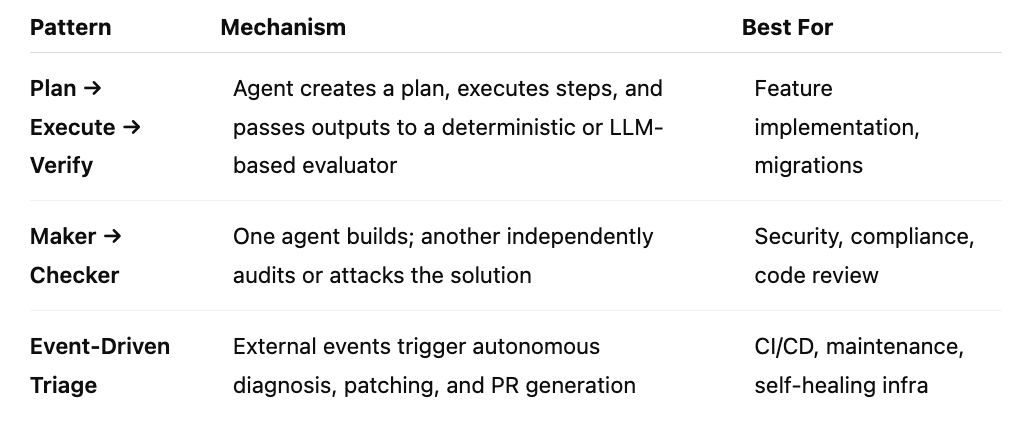
These patterns appear repeatedly in production AI architectures.
4. The Hidden Cost: Comprehension Debt
Loop Engineering dramatically increases development velocity.
But it introduces a dangerous new failure mode:
Comprehension Debt
Comprehension Debt is the gap between the code in production and the team’s actual understanding of that code.
When autonomous loops continuously refactor modules, patch vulnerabilities, and ship fixes, the repository evolves faster than humans can absorb.
Everything looks fine—until it breaks.
Then the real problem emerges:
No one understands the system deeply enough to debug it.
This is one of the biggest unsolved challenges in autonomous software engineering.
Mitigating Comprehension Debt
1. Treat Documentation as a First-Class Artifact
Your loop should automatically update architectural knowledge.
Maintain files such as:
AGENTS.mdSKILLS.mdarchitecture decision records (ADRs)
When an agent changes a core design pattern, it should document:
What changed
Why it changed
Tradeoffs considered
Documentation should evolve with code.
2. Keep Humans in the Merge Loop
Autonomy should stop before the production merge.
A healthy termination rule is:
The agent must produce a clean Pull Request with a structured summary explaining what changed and why.
Humans still own final approval.
This preserves accountability and system comprehension.
Human-in-the-loop review remains critical for high-stakes production systems.
Moving Forward
The market is rapidly moving beyond prompt engineering.
Prompting still matters—but prompts alone do not build reliable systems.
Control systems do.
Your value as an AI Engineer is no longer measured by how well you talk to LLMs.
It is measured by your ability to build systems that make LLMs:
Reliable
Observable
Bounded
Self-correcting
Safe in production
Stop thinking in prompts.
Start thinking in loops.
The best AI engineers of the next decade will not merely write prompts.
They will design the control systems that govern intelligence.


